
Description
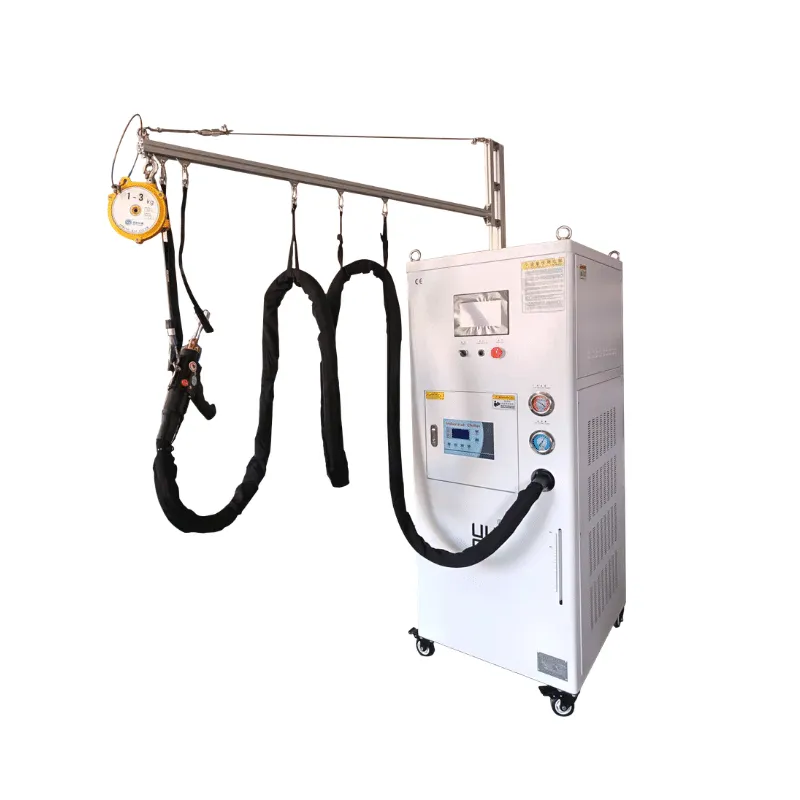
Eminduct specializes in developing induction heating control systems, offering customizable programs tailored to diverse processes. It accommodates varying pipe diameters, materials, heating temperatures, and welding parameters—a single machine serves multiple purposes with controllable temperature, heat retention, and temperature measurement capabilities. For welding different materials and sizes, a single welder allows parameter settings via the screen, enabling sequential automatic welding.
(I) Technical Principle
Induction heating originates from the electromagnetic induction phenomenon discovered by Faraday, wherein an alternating current generates an induced current in a conductor, causing the conductor to heat up.
The induction heating power supply primarily consists of an inverter, a resonant unit, a transformer, and an inductor. The inverter functions as a converter that transforms AC power from the utility grid into medium-frequency or high-frequency electrical energy ranging from several thousand to several hundred kilohertz. The resonant unit and transformer connect one end to the inverter and the other end to the inductor, converting high voltage into isolated low voltage while performing impedance matching. During heating, powerful high-frequency currents flow through the inductor, inducing currents in the conductor material, thereby rapidly heating it. The resonant frequency of the induction heating power supply varies depending on the heated object and process, with frequencies typically ranging from 1 kHz to several tens of kHz being most commonly used.
(2) Advantages of the HYST Series Products
High Efficiency: The patented handheld transformer achieves 100% magnetic field energy conversion, maximizing electromagnetic conversion efficiency at the source.
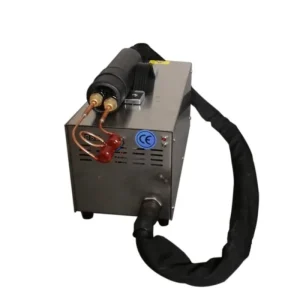
Portability: Connecting the compact handheld transformer to the UHF induction heating power supply via a flexible coaxial water-cooled cable enables convenient induction heating of hard-to-reach workpieces.
Intelligent: Custom-designed induction coils tailored to your requirements, combined with specialized heating programs, simplify welding tasks traditionally requiring skilled technicians into routine operations achievable by following preset procedures.
Reliable: Utilizes IGBT soft-switching technology alongside comprehensive water and electrical protection systems to ensure long-term equipment durability.
Environmentally Friendly Widely applicable for heating various conductive metals, it offers advantages such as no open flames, fully electrical operation, no combustible gases, and clean, pollution-free operation.
(3) HYST Series Product System Composition
Main Unit:
Power Source: Supports manual and automatic continuous power adjustment. Equipped with a 4-20mA control signal interface to regulate power within specified ranges.
Automatic Control System: Achieves time-controlled and temperature-controlled heating based on signals from temperature sensors and other sensors.
Intelligent System: Integrates insights from domestic and international welding experts with years of proven experience to generate optimal heating curves based on actual workpiece parameters. Operators can make necessary adjustments according to real-world conditions and design custom heating parameters based on operational expertise, achieving expert-level heating control.
Water Cable:
Connects the main unit to the handheld transformer. Utilizes coaxial forced water-cooling technology, enabling continuous bending and extension to adapt to complex working environments.
Handheld Transformer:
Comprising a high-frequency transformer system and water cooling system, it supplies electrical power to the induction coil.
User-Friendly Flexibility: Featuring an innovative compact design, the 15kW handheld transformer weighs only 1kg, enabling flexible one-handed heating operations.
High Efficiency & Energy Savings:
The coaxial forced water cooling design effectively resolves transformer heat dissipation issues. The unique sealed single-coil design achieves highly concentrated magnetic field energy with absolutely zero leakage.
Induction Coil
Advanced magnetic field shaping technology ensures magnetic energy is released within the specified area, achieving true localized heating.
Induction Coil Characteristics
Concentrated on objects near the coil, induction heating exhibits stronger effects on surfaces and weaker effects internally. This principle allows targeted heating of specific areas on the workpiece, achieving instantaneous heating to enhance production efficiency and work quality.
Induction Coil Advantages
Rapid heating: Reaches target temperatures within seconds compared to other methods.
Localized heating: Heats only required areas, conserving energy.
Environmentally friendly: Produces no harmful substances.
Temperature Control System
Precise closed-loop heating control based on the temperature curve of the workpiece, meeting expert system requirements.
(IV) HYST Series Product Features
Faster
Delivers more energy per square millimeter than flame heating. In other words, it can weld more parts per hour than other brazing methods.
Enhanced Productivity
Ideal for in-line brazing, eliminating the need to transport or store batches near brazing equipment. Electrical controls and custom-designed coils enable seamless integration of the brazing process with production lines.
Consistent Performance
Induction heating offers controllability and repeatability. By inputting desired process parameters into the induction unit, it repeats cycles with minimal deviation.
Unique Controllability
Induction heating allows operators to observe the brazing process—a challenge with flame welding. Its controllability and precise heat transfer minimize overheating risks, preventing weak joints. Temperature control can be maintained within ±2°C to meet specific process requirements.
A More Efficient Work Environment
Flame heating creates an uncomfortable working environment, reducing operator motivation and productivity. Induction heating is exceptionally quiet and does not raise the temperature of the surrounding area.
Space-Saving
The compact design of the HYGP series brazing equipment allows its induction coils to be easily integrated into production units and existing layouts. Our equipment is also compact and portable, facilitating the welding of more complex and hard-to-reach workpieces.
Non-contact heating
Induction heats only the base material, leaving surrounding areas untouched. This non-contact process prevents flame exposure, safeguarding against warping and deformation to enhance yield and quality.
(V) Application Fields of HYST Series Products
1. Electrical Brazing: Integral brazing of conductors, stranded wires, leads, splice heads, cables, and shorting rings in electric motors, generators, and transformers.
2. Automotive Brazing: Aluminum components in AC systems. Connections in evaporators and compressors (tube-to-tube, tube-to-housing, tube-to-casing); steel and copper components such as brake calipers and fuel lines; shorting rings in electric motors.
3. Home Appliance Brazing: Compressor components, dishwasher heating elements, washing machines (tube-to-tube connections, tube-to-housing connections, tube-to-valve connections), faucet brazing (tube-to-base connections, threaded sleeves).
4. Tool Brazing: Drill bits, saw blades, lathe and planer tools, mining and related industry tools.
5. Heat treatment in metalworking: Includes processes like quenching, annealing, and tempering for shafts, bearings, gears, cutting tools, steel pipes, and steel strips.
6. Induction heating: Primarily used for hot forging, where metal is heated to specific temperatures before shaping into various forms.
7. Melting: Molten metal for steelmaking, casting, etc.
8. Welding: Medium-frequency induction welding or auxiliary heating during welding processes. Applicable to high-precision welding scenarios such as liquid diffusion welding and brazing. Examples include silver-copper welding of generator stator bar ends and leads, welding of large-scale air conditioner thin-walled tubes or aluminum pipes, oil pipeline welding and hotline repairs, and transformer winding brazing.
9. Heat-shrinking: Heating shafts and rings for assembly, e.g., heating motor rotors before shaft installation.
10. Indirect heating of non-metals: Complex insulated-metal hybrid structures, such as fusing and curing the involute segments of generator stator bars.
(VI) Operating Environment Requirements
Temperature and Humidity: Derating is required when the operating environment temperature exceeds 45°C, with a maximum limit of 45°C. For every 1°C increase above 45°C, derating by 5% is applied. Relative air humidity must remain below 95% without condensation. Avoid placing the machine in direct sunlight.
Reviews
There are no reviews yet.